
Deep Dives
Europe’s Next Edge: Competitiveness Through Depth
For decades, Europe’s answer to industrial risk was simple: bring production back home. That answer is no longer enough. Reshoring alone does not guarantee strategic depth. Real resilience depends on which technologies we control, where we scale them, and who funds that growth. Europe leads in research and early-stage innovation, yet many promising companies still struggle to find the long-term capital they need to grow here.
This article explores the shift from reshoring to deepshoring, examines where strategic depth matters most, and outlines how investors and policymakers can align patient private capital with industrial priorities. The goal is to rebuild Europe’s economic resilience. Reindustrialization is no longer a question of location. It is a question of financing and integration.
The paradox of plenty
Europe is entering a new industrial era not defined by scarcity, but by a lack of coherence. While more than €414 billion of dry powder sits in European private equity and venture capital funds, only €126 billion was deployed in 2024. (Source: Invest Europe, Activity Data and Market Statistics, 2024) Capital is available, yet risk appetite for long-cycle, capex-intensive industrial value creation remains limited.
At the same time, Europe remains structurally dependent on external suppliers. In the semiconductor value chain, nearly 80 percent of input suppliers are located outside Europe, reflecting deep integration with non-European markets. (Source: European Commission Joint Research Centre, Semiconductor Supply Chains and Strategic Dependencies ) In battery value chains, Europe accounts for only about 7 percent of global cell production and remains heavily reliant on imports for critical materials such as lithium, nickel, and manganese. (Source: European Commission, EU Battery Value Chain and Strategic Dependencies; ACEA data) In pharmaceuticals, around 69 percent of medicinal product imports originate from outside Europe. (Source: Eurostat, International Trade in Medicinal and Pharmaceutical Products) Public policy is responding, with up to €70 billion in sovereignty funds and EIB-backed programmes being mobilised between 2024 and 2027. (Source: European Investment Bank, Annual Report 2025 )
The core challenge is clear. Europe can subsidise production, but competitiveness requires conviction: long-term capital aligned with industrial depth.
From Reshoring to Deepshoring: Why Depth Beats Scale
Europe’s industrial policy has entered a new phase, moving beyond reshoring toward what can be called deepshoring: rebuilding not only factories, but the most value-dense layers of industrial production. The focus has shifted from the number of plants to the control of critical segments of the value chain, including materials processing, core components, and advanced manufacturing steps.
Between 2018 and 2024, documented industrial reshoring initiatives in Europe largely took place within existing regional value chains rather than through full relocation from third countries. (Source: Eurofound, Reshoring in Europe: Recent Trends and Policy Implications, Restructuring Monitor Database) Available evidence suggests that reshoring has remained limited in scale and has predominantly involved incremental adjustments. (Source: OECD, Reshoring: Myth or Reality?; OECD Trade and Industry Policy Papers on global value chain reconfiguration)
As a result, Europe’s industrial renewal will be selective rather than comprehensive. The strongest opportunities lie in sectors where high technological complexity, long capital cycles, and strategic relevance intersect. In these areas, partial control over key production stages can deliver both economic returns and strategic resilience, while other segments will continue to rely on global collaboration.
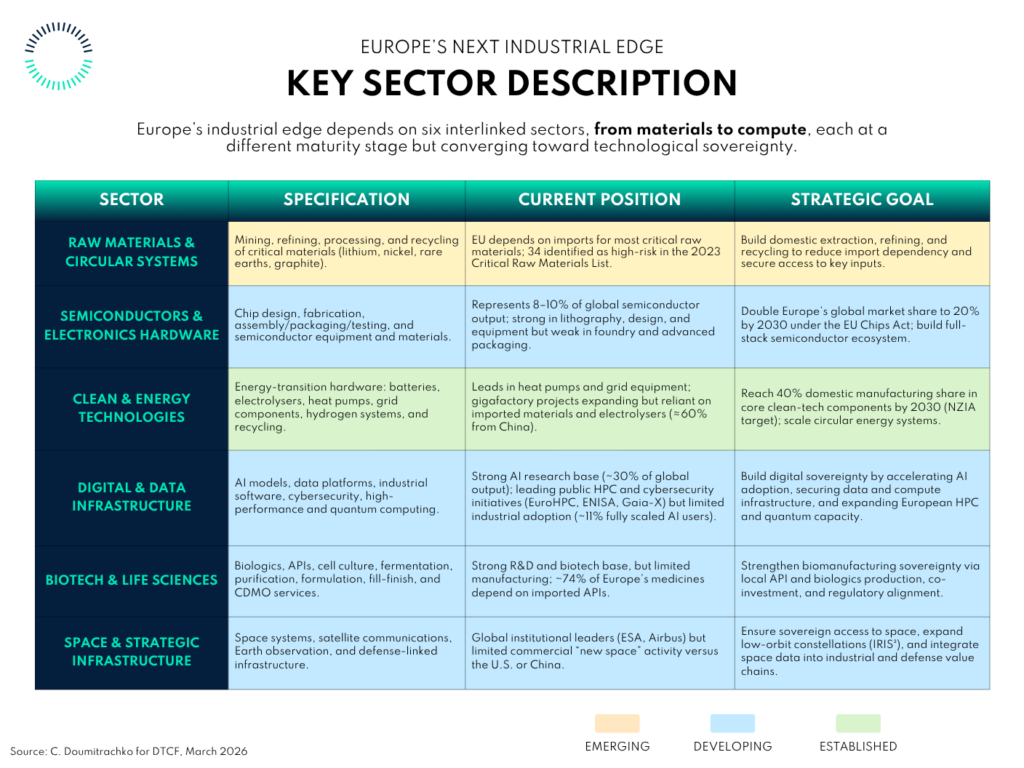
The following overview identifies six industries where Europe is positioned to deepen its industrial role over the next decade. Across all of them, success will depend less on individual projects than on shared enablers: access to specialised talent, scalable advanced manufacturing capacity, and financing structures capable of supporting the long transition from research and pilot production to industrial deployment.
The following sector maturity graphic compares six strategic sectors by how close Europe is to translating technological capability into industrial sovereignty. Sectors are classified as Emerging, Developing, or Established based on industrial capacity, investment readiness, and technological depth across the value chain. The framework reflects Europe’s current structural position and highlights remaining constraints such as scaling bottlenecks, integration gaps, and external dependencies.
Europe’s investment rhythm is shifting
As public institutions seek to stabilise liquidity, private investors are recalibrating from fast exits toward longer holding periods and deeper value creation. Average holding periods increased to 5.7 years in 2024, up from 4.7 years in 2020, indicating a shift away from short-cycle returns toward industrial integration and profitability. (Source: Invest Europe, Private Equity and Venture Capital Activity Data, 2024)
Sector allocation in 2024 remains dominated by ICT, telecom, and technology investments at around 32 percent, while biotech and healthcare increased their share to approximately 14 percent, and traditional industrial sectors declined slightly. (Source: Invest Europe, European Private Equity Market Statistics, 2024)
Public capital is increasingly acting as a market catalyst. Initiatives such as the European Tech Champions Initiative, Capital Markets Union 2.0, and national and European sovereignty funds, amounting to up to €70 billion between 2024 and 2027, reinforce the same strategic direction: linking financial depth to industrial depth. (Source: European Investment Bank, Annual Report 2025; European Commission communications on CMU 2.0 and sovereign investment instruments)
Where Deepshoring Is Already Taking Shape
Ferroelectric Memory Company (FMC) is a standout example. The Dresden-based semiconductor pioneer develops next-generation memory chips (DRAM+ and 3D CACHE+) based on ferroelectric hafnium oxide, a technology critical for AI, edge computing, and energy-efficient data infrastructure. In late 2025, FMC closed a €100 million funding round, led by HV Capital and backed by the European Innovation Council, DeepTech & Climate Fonds (DTCF), and other strategic investors to accelerate commercialisation and expand global reach. Around €23 million of the round came from public funding, underscoring how blended finance can help bridge the capex intensity of sovereign technologies. The company is also advancing plans for a chip fabrication facility in Germany, potentially supported by up to €1.3 billion in federal and European incentives, a test case for Europe’s ability to finance sovereign semiconductor production.
CorWave represents a further case from the health sector. The French medical-device company develops next-generation cardiac assist systems based on wave-membrane technology. Operating in a highly regulated and technologically demanding environment, CorWave combines advanced materials, precision manufacturing, and complex system validation. The company has raised substantial private capital alongside European and national public support to finance long development cycles, clinical trials, and industrialisation. Rather than relying on global contract manufacturing, CorWave is anchoring core production and qualification capabilities in Europe, showing how patient capital can support sovereignty-relevant manufacturing in health technologies.
Genomines provides another example. The Paris-based deeptech startup is transforming how critical metals are sourced. In September 2025, Genomines raised an oversubscribed $45 million Series A co-led by Engine Ventures and Forbion BioEconomy, with participation from the DeepTech & Climate Fonds (DTCF) as well as industrial and climate-focused investors. The funding supports the scale-up of its bio-based extraction platform for battery-grade nickel, a material central to electric mobility and energy storage, reducing reliance on carbon-intensive mining methods and strengthening supply-chain resilience.
Skeleton Technologies, headquartered in Estonia, illustrates industrial depth in energy storage. The company develops graphene-based supercapacitors and has raised tens of millions in a mix of private and public funding, including European Innovation Council grants, EIB backing, and national support programmes. Skeleton demonstrates how modular, infrastructure-relevant energy technologies can be financed and industrialised across multiple development stages.
The Way Forward
Europe’s future competitiveness will not be built on scale, but on depth. Durable advantage will accrue to those willing to invest in precision, complexity, and long integration cycles across critical industrial value chains.
For investors, this implies a shift in focus: away from short-cycle scalability and toward segments where technological depth, capex intensity, and strategic relevance intersect. These are the parts of the value chain where value compounds over time—and where resilience becomes a structural outcome.
At DTCF, we invest in founders and partners who understand that building Europe’s industrial backbone requires conviction, patience, and capital aligned with industrial reality.